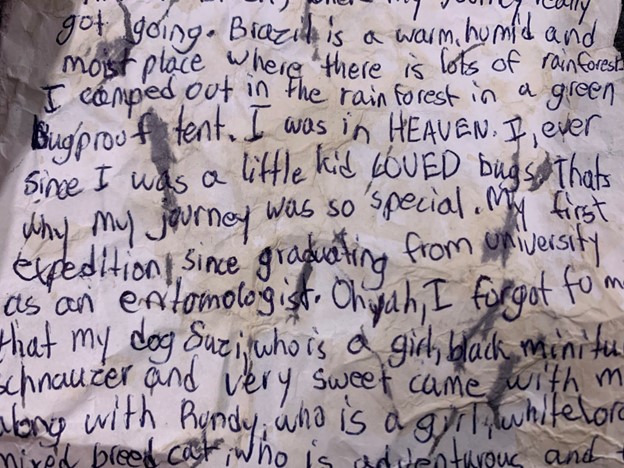
If you asked seven-year old me what I wanted to be when I grew up, I would have told you: an entomologist. My heart was filled with passion for bugs. I made friends with grasshoppers on marigolds, worms in the dirt, and ladybugs that landed on my hand. I filled a fourth-grade message-in-a-bottle, imagine-your-future-self assignment with an idealistic description of my prospective career researching my favourite type of caterpillar1 . Current me, undecided in my career path, looks back and admires her single-minded devotion to her interests.
What was I like at that age, long before entering the complex labyrinth of adult life? Maybe there are hidden clues, guideposts for my future self. I was precocious, an early reader, a bossy older sister, a daydreamer. Always a devoted bookworm, the kind of child to take out teetering stacks of books from the library and to come back the next week ready for more. I liked to draw and filled pages with my doodles, completely unconcerned with their quality, immersed simply in the joy of creation.
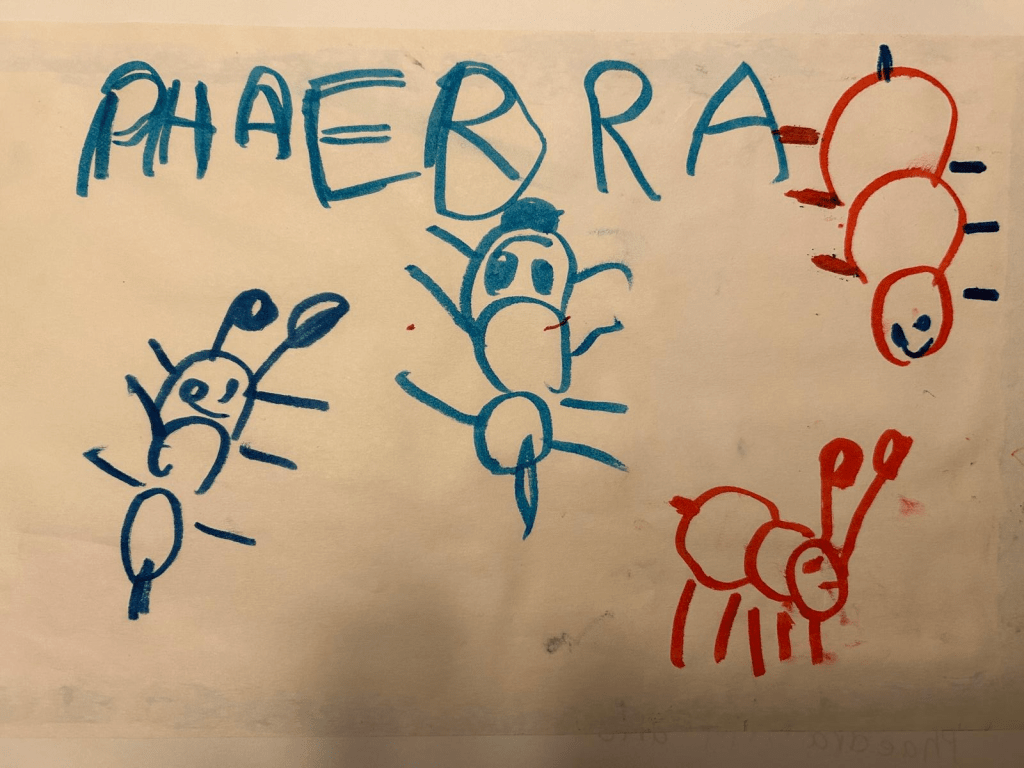
I discovered fan-fiction at the tender age of 3, drawing pictures of Worm from early reader books2 and dictating to my mom which words should go along with them. At age 10, I began a story about my dogs running away to the off-leash park to start a new life, the vision much grander than my actual output of several loose-leaf pages. When I turned 12, my new dream solidified: I wanted to be a writer. This was the beginning of my love affair with fiction writing. I decided that from then on, I would always be writing a novel (and here I am, still at it–sometimes the going is faster, sometimes it’s glacially slow, but still there is always a novel sitting in the back of my mind, percolating and waiting for me to return to it).
As a preteen and teenager, I drew comics about my dogs. I wrote fantasy novels with my best friend and by myself. I drew endless iterations of the characters in my stories.
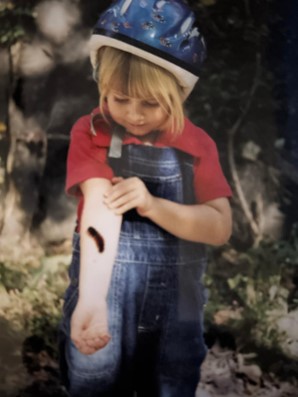
At age 15, I wrote this poem for an English assignment, in response to the picture that begins this post:
This is a Photograph of Me
Phaedra Berger
Young me, four years old
Standing on a forest trail
Along the Missouri River
Biking with my family and
My new friend, a caterpillar
A Woolly Bear caterpillar
Who crawls up my arm
Inch by inch
I’m standing there
Small, short, innocent
Fascinated by the tiny wonders of the world
Red shirt, jean overalls
A blue helmet, tilted on my head
Covered with colourful stickers of fish
I am both
Little girl and
Fuzzy red and black caterpillar
Both are small and alone
In a big world
Questioning, curious, looking with fresh eyes
Unjaded by the troubles
And problems yet to be faced
But yet
The little girl is growing up
And all things must come to an end
Or change
I am just like the caterpillar
Who
After a life on the ground
Will turn into a butterfly
Spread her wings
And fly
I wanted to be a writer, but I was afraid of telling people that’s what I wanted to be. Creative careers, of course, are not known to be the most financially secure, and various forces in my life, internal and external, nudged me away from pursuing it wholeheartedly.
I graduated high school and started university as an undeclared Arts & Science major. What to pick as my direction? Maybe English, some people in my life suggested, given my love of writing. Pre-med, suggested others, based on my success in school. The decision intimidated me. After my first year, I finally settled on psychology as my major. I thought it was fascinating: the study of the human mind. What did I want to do with it? I wasn’t sure. Maybe counselling, or the long road to become a psychologist.
I fell in love with programming in my second year of university and went on to make a multitude of Processing games, adopting a second major in the process. I took classes in a range of subjects, including psychology, art, computer science, biology, and art history. I kept working on my novel. I completed an undergraduate psychology honours thesis in the area of cognitive psychology, discovering the thrill of research. For one of my final classes, I was team lead of a nine-person group for a video game design class and we ended up publishing our 2D platformer with a unique physics twist on Steam (here it is, if you want to check it out).
I received dual undergraduate degrees in psychology and interactive systems design, and then was faced with yet another instance of the endless forking decision points that make up life: what should I do next?
My life has been characterised by competing pulls: towards creative writing, towards visual art, towards psychology, towards computer science. The world has a tendency of separating art and science into two very separate bins, when really they are more connected than you would think–many of the world’s most creative and prolific minds have been deeply involved with both.
I thought about what I wanted to do with my life and took a gap year–travelled, worked on my novel, and got a puppy (hi Cosmo!). I enjoyed the freedom and opportunity to work on my personal projects, but I missed the intellectual stimulation and exposure to interesting people and experiences that came with university.
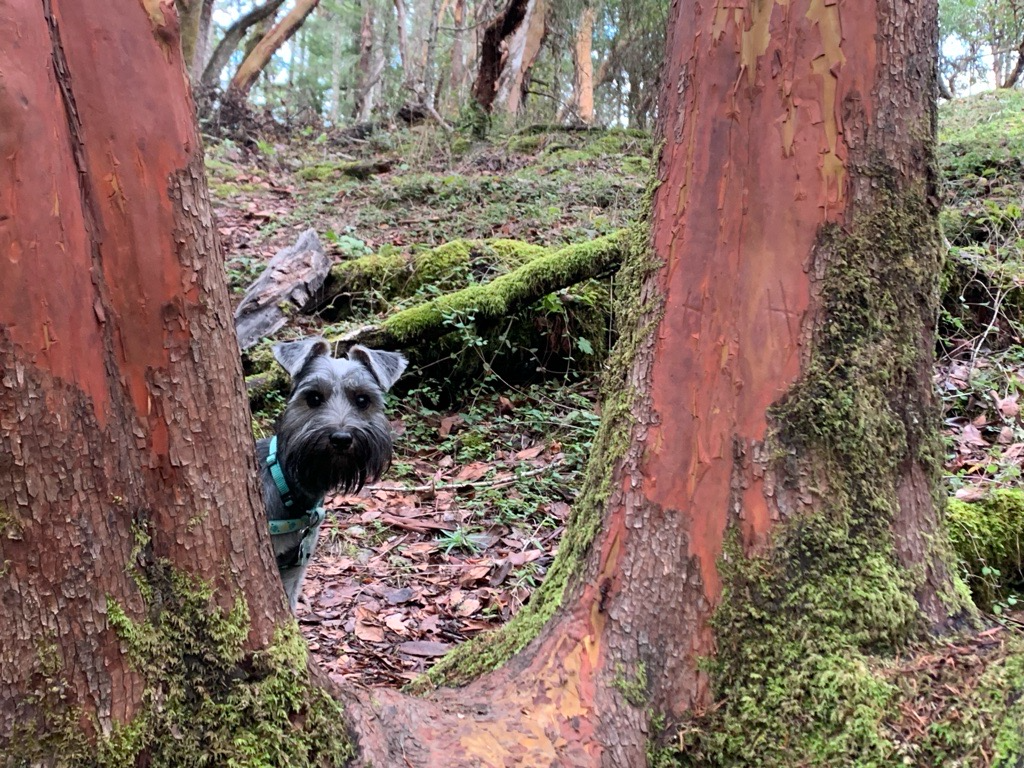
Following my gap year, I made a decision: I was going to do a Master’s degree in Computer Science, specialising in the area of human-computer interaction, with a thesis topic related to creativity and well-being in digital spaces.
So here I am again, full-circle to my seven-year old self, a scientist in training. My interests may have wandered since my early all-consuming passion (though I still smile whenever I see a caterpillar and Caterpie is my favourite Pokémon), but the animating force of enthusiastic curiosity remains.
Except a Master’s degree is so short: only two years. Here I am, halfway through, and I’m already faced with the question of: what to do next?
The conventional career paths for someone with a computer science master’s degree are industry or academia. Then there’s my teenage dream: a freelance creative career, an option so massively intimidating I’m not sure how I’d even begin.
Life is short, but it’s also long, especially if you’re where I am now, staring out at the vast gulf of the unknown: decades of adult life with no certain idea of what to fill it with.
What should I do? Get a PhD and pursue academia? Try to find a job in the tech industry? Get a part-time job in a bookstore and work on my high school dream of becoming a fantasy fiction writer? Work as a web developer or get into UX design? Get involved in science communication, a broad field at the intersection of science, education and the arts that brings science concepts to a wider audience (think along the lines of Hank Green3 or Carl Sagan)?
There is a multiverse of potential versions of me out there, invisible and overlapping, branching off different points in my timeline. I just need to find my way into taking the next step towards becoming this version of myself.
What do I want to do with my life? I want to read books, I want to go for walks with my dog, I want to create things, I want to build meaningful connections with other people.
“There are infinitely many kinds of beautiful lives,” wrote blogger and curator of ideas Maria Popova4 in her book Figuring.
“Do not try to do extraordinary things but do ordinary things with intensity,” wrote artist Emily Carr in her journals.
“Don’t ask yourself what the world needs. Ask yourself what makes you come alive, and go do that. Because what the world needs is people who have come alive,” wrote teacher Gil Bailie, quoting the remembered words of theologian Howard Thurman5.
My most enduring dream was always to be a writer.
A library writer-in-residence once told me that the way to approach a writing career was through building a writing CV. And through my cognitive psychology classes, I know that the best way to build a skill is through deliberate practice.
And so: the Blog.
For years, I’ve dabbled with the idea of starting a blog. The medium suited my eclectic collection of interests, the meandering tendencies of my brain, and the multifaceted nature of my ideas.
But of course, there remained the old fears: of announcing my desire to be a writer and putting my words out into the world where they could be seen. What if my work wasn’t perfect? What if I made a mistake? What if someone disagreed with me?
Social psychologist and writer Brené Brown explored this fear and its opposite: the power of vulnerability, in her book Daring Greatly.
She opens the book with this quote from Theodore Roosevelt:
“It is not the critic who counts; not the man who points out how the strong man stumbles, or where the doer of deeds could have done them better.
Theodore Roosevelt
The credit belongs to the man who is actually in the arena, whose face is marred by dust and sweat and blood; who strives valiantly; who errs, who comes short again and again,
because there is no effort without error and shortcoming; but who does actually strive to do the deeds; who knows great enthusiasms, the great devotions; who spends himself in a worthy cause;
who at the best knows in the end the triumph of high achievement, and who at the worst, if he fails, at least fails while daring greatly….”
In the spirit of daring greatly, I want to give it a try.
So this blog is many things: a place to practise writing, an environment to explore my interests, a personal log for my career journey, and an archive for books, links and cool people I stumble across in my adventures.
In summary: a network of possible wanderings.
Which brings us to this blog’s title. I chased the reference down rabbit holes to its origin, from my memory to an article I read for my thesis research to the book it originated from. It’s described as an “intellectual space [used] to explore and solve problems” in a 1998 article called “How to Kill Creativity”6 by Teresa Amabile and “the whole space of search paths that are accessible to an [information processing system]” in its root source, the 1972 book Human Problem Solving by Allen Newell and Herbert A. Simon.
That’s what I envision this blog to be: a network of my interests, ideas, thoughts and experiences. The phrase is poetic and intellectual, evoking the exploratory nature of the creative process, originally coined by Herbert Simon, a pioneer in both computer science and cognitive psychology. To me it represents the expanse of my passions: both arts and science, acting as a bridge between them.
So what will I be writing about on here? Things I’m passionate about, such as: the creative process, psychology, scientific research, well-being, mental health, queer sci-fi/fantasy books7, literature analysis, art, dogs, nature, biology, neuroscience, programming, and game design–whatever happens to be the current focus of my curiosity. I’ll keep a log of books, articles, and other thinkers and creators that inspire me. I’ll take inspiration from my thesis topic and try to improve my happiness with mini creative challenges.
Will I keep it up? We’ll see. Maybe I’ll bounce off onto something different, like I have with many hobbies in the past. Or maybe it will stick, and this will be the beginning of a lovely long-term project.
In any case, here’s to taking the next step!
- The puss moth caterpillar ↩︎
- Specifically these ones from the “Well Done, Worm!” series by Kathy Caple ↩︎
- Who, among many other things, makes entertaining and informative YouTube videos ↩︎
- For more examples of Maria Popova’s writing (and for thought-provoking book recommendations), visit: The Marginalian ↩︎
- I learned from searching for this quote that there is a website dedicated to tracing the history of quotations ↩︎
- Read it online here, for advice that I think is still relevant ↩︎
- Shout out to one of my favourites: The Locked Tomb series by Tamsyn Muir ↩︎
 A Network of Possible Wanderings